
Answer engine optimization is the single biggest shift in search marketing since mobile-first indexing — and in 2026 it is no longer optional. If your brand isn’t being cited by ChatGPT, Google AI Overviews, Perplexity, Gemini, and Copilot, you are invisible to a fast-growing share of buyers who never scroll a traditional results page. This guide breaks down what answer engine optimization is, how AEO differs from SEO and GEO, the tactics that actually move citations, and the tools worth your budget this year.

Table of Contents
What Is Answer Engine Optimization (AEO) and how it helps you make the best of decisions for your business?
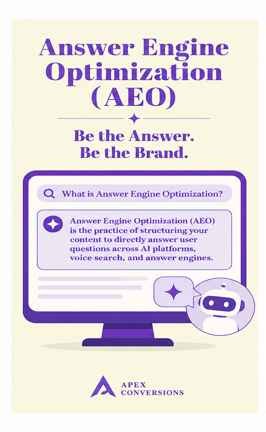
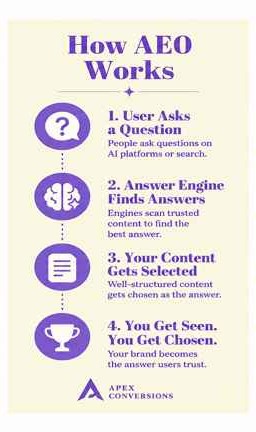
Answer engine optimization is the practice of structuring your content and online presence so AI-powered answer engines surface and cite your brand accurately. Where classic SEO chases a blue-link ranking, AEO chases inclusion inside the synthesized answer itself — the paragraph ChatGPT writes, the box Google shows above the links, the source list Perplexity attaches to a response.
You’ll see the same idea and term Answer Engine Optimization sold under several names: generative engine optimization (GEO), AI SEO, LLM optimization (LLMO), and AI search optimization. The terminology fight is mostly noise. Wikipedia uses the term GEO. Also lists AEO, LLMO and AIO as other names for the same thing. On the hand Googles documentation, from 2026 says that all of this is just a part of modern SEO.
No matter what you call it the goal of GEO is the same. The goal of AEO is the same. The goal of LLMO is the same. The goal of AIO is the same. The main mission of GEO and AEO and LLMO and AIO is to become the source that the machine trusts.
The mission of GEO and AEO and LLMO and AIO is to be the one that the machine goes to for information.
Why Answer Engine Optimization matters right now
The numbers explain the urgency of Answer Engine Optimization. Over 60% of Google searches now end without a click to an outside website, and AI Overviews are accelerating that “zero-click” reality. Ahrefs found AI Overviews cut click-through rates for top-ranking pages dramatically year over year.
The most important development of 2026 came with Google’s May Core Update. Traditional rankings and AI citation visibility are not connected like they used to be. In the past the top 10 search results were where you would find most of the information that AI systems used. In mid-2025 these top results made up 76 percent of the information that AI systems used. By early 2026 this number had dropped to, around 38 percent according to a study done by Discovered Labs. This means that even if you are ranked number one you are not automatically the answer that people will see. You have to optimize for citation, not just position.
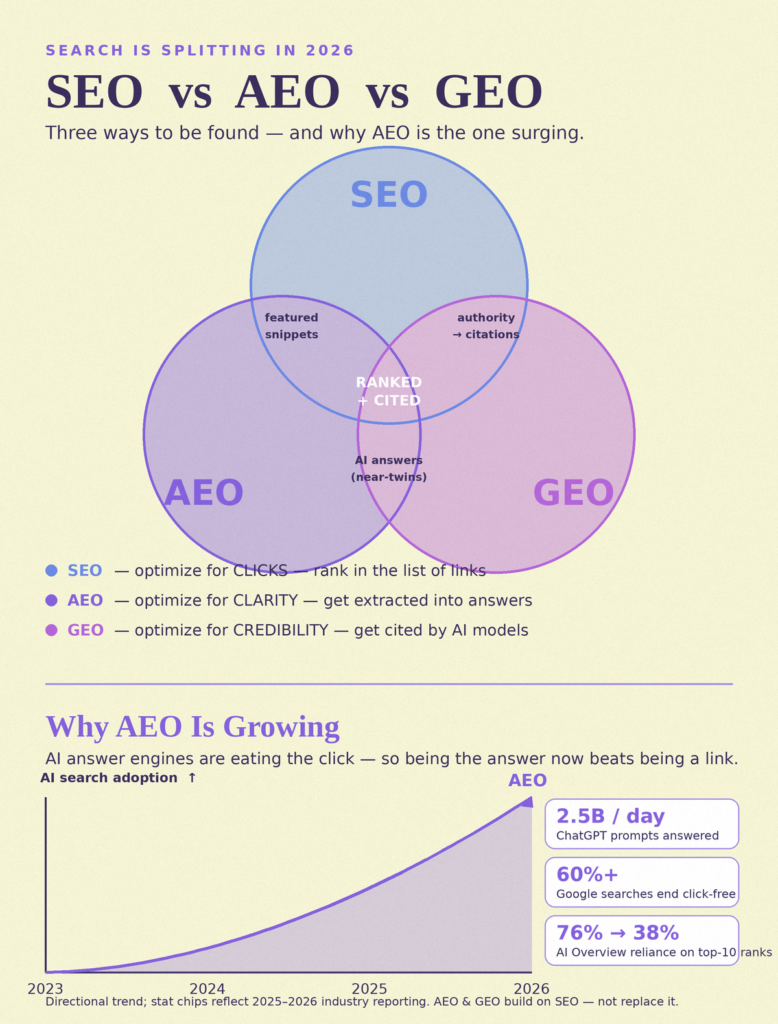
Answer Engine Optimization vs SEO vs GEO: Same Goal different lenses
These three overlap, but it is important to know when, what is useful when you plan content:
- SEO (Search Engine Optimization) optimizes for clicks — earning a high rank in the list of links on Google and Bing.
- AEO (Answer Engine Optimization) optimizes for clarity — getting your facts cleanly extracted into featured snippets, voice answers, and AI answer boxes.
- GEO (Generative Engine Optimization) optimizes for credibility — convincing large language models to cite you when they synthesize a response in ChatGPT, Claude, or Perplexity.
Here is the part most marketers get wrong: GEO and AEO do not replace SEO. They expand it. Nearly 40% of Google’s AI Overviews still pull from pages ranking in the top 10 organic results, and almost 70% rank in the top 100. A strong SEO foundation remains the launchpad for AI visibility — you are building a second floor, not demolishing the first.
The Answer Engine Optimization Playbook that Worked Wonders
When Princeton researchers ran the first big empirical study of generative optimization across thousands of queries, they found concrete, repeatable levers. Use them.
1. Add expert quotes and authoritative attribution
Adding genuine expert quotes lifted citation visibility by roughly 41% in the Princeton GEO research. Language models treat quotation marks and named attribution as a proxy for credibility. Interview a practitioner, cite a named source, and attribute claims clearly.
2. Lead with statistics and original data
Including statistics boosted visibility by about 30%. Numbers signal factual density, which answer engines reward. Even better, run your own surveys or benchmarks — original research is one of the strongest, most defensible GEO signals because it gives the model something it can only get from you.
3. Use inline citations
Inline citations lifted visibility by roughly 30% by building a visible chain of trust. Link out to primary sources, studies, and official documentation.
4. Write extractable, answer-first passages
AEO rewards passages that a machine can lift cleanly. Make sure that each section has an answer in the first few words, then expand. Using clear H2 and H3 questions that show exactly how people actually prompt: long, conversational, full-sentence queries rather than two-word keywords.
5. Stop keyword stuffing
The Princeton work found keyword stuffing actually reduced citation probability by about 9%. Stuffing degrades natural flow, and models detect that through perplexity scoring. Write for clarity, not density.
6. Build cross-source consistency
LLMs favour information that appears consistently across independent sources. Make sure your key facts like founding date, leadership, product claims, pricing structure — match across your site, your LinkedIn, your PR, and third-party listings. Inconsistency erodes machine trust.
7. Get the technical foundation right
You need to make your content easy for machines to understand. This means you should have clean schema markup for things, like Asked Questions, How-To guides, Articles and Organizations. Your headings should also be organized in a way. It is important that your website loads quickly and that the HTML code can be crawled by machines.
In the year 2026 it is an idea to have a file called llms.txt at the root of your website. This file helps guide intelligence crawlers to your site. You must also check your robots.txt file to make sure it is not accidentally blocking these intelligence crawlers.
8. Optimize per platform
Each engine behaves differently. Google AI Overviews mostly pull from top-10 results, so SEO-first. Perplexity rewards freshness and authority. Microsoft Copilot leans heavily on LinkedIn for B2B queries. Claude favours long-form, comprehensive guides. Gemini analyses multimodal content — so video and images matter. Map your priority platforms to where your buyers actually ask questions.
Best Answer Engine Optimization and GEO Tools for 2026
You can’t improve what you can’t measure, and traditional rank trackers don’t see AI citations. These platforms do:
- Profound — the most comprehensive surface coverage, tracking 10+ AI systems including ChatGPT, Perplexity, Gemini, Copilot, Claude, Meta AI, Grok, and DeepSeek. Backed by a large Series C at a billion-dollar valuation, it starts around $99/month for single-platform monitoring.
- Scrunch — a full-workflow AEO/GEO platform (monitoring, auditing, optimization, content delivery) aimed at enterprises and agencies, with plans from roughly $250/month.
- SEMrush AI Visibility Toolkit — the natural add-on if your team already lives in SEMrush for SEO; folds AI visibility into familiar dashboards.
- Otterly.AI — the most accessible entry point, starting around $29/month for a small set of tracked prompts. Great for testing the channel before committing.
- Nightwatch — affordable fan-out query visibility from about $32/month base, and notably it surfaces the real-time searches an AI runs before composing its answer.
- Athena HQ, Peec AI, and Adobe LLM Optimizer — strong picks for brand tracking, multilingual/global teams, and Adobe Experience Cloud shops respectively.
One critical warning for agencies and clients alike: nobody can guarantee placement in AI answers. Anyone promising guaranteed citations is running a scam. Buy tools that measure and diagnose, not vendors that promise the impossible.
How to Measure Answer Engine Optimization Success
Throw out click-only KPIs. Track these instead:
- AI citation share — how often you’re cited versus competitors for your priority prompts.
- Brand mentions in generated answers (cited or uncited).
- Referral traffic from AI platforms — segment ChatGPT, Perplexity, and Gemini referrers in analytics.
- Conversion rate from AI-referred visitors — early data suggests these visitors often convert higher, because they arrive pre-educated and closer to a decision.
That last point reframes the whole “zero-click” panic. Volume of clicks may fall, but the value per click that does come through can rise. A buyer who reaches you after an AI has already vetted you is a committed buyer.
How to Get Cited by ChatGPT: Off-Page Answer Engine Optimization Signals
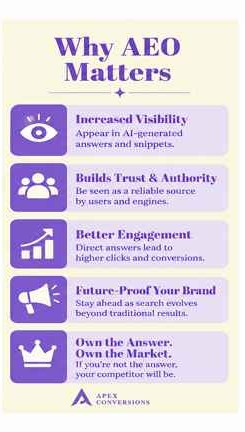
Most teams obsess over their own website and forget that AI answer engines pull from the entire web. A large share of ChatGPT, Perplexity, and Gemini citations point to third-party sources — Reddit threads, YouTube videos, Quora answers, review platforms, industry directories, and Wikipedia. If your brand only exists on your own domain, you are leaving most of the citation surface untouched.
Off-page AEO is the discipline of earning mentions on the pages AI already trusts. Three moves matter most. First, invest in digital PR: a single mention in a respected publication can be re-surfaced by an LLM for years. Second, get included in third-party “best of” and comparison roundups for your category, since these listicle-style pages are citation magnets for buyer-intent prompts. Thirdly, join communities like Reddit.
Niche forums. Share your thoughts. This helps because AI looks at where honest answers come from.
The goal is easy to understand. When AI puts together an answer it should see your name in different places. Not just, on your homepage.
You want to be seen in lots of places, not one. This way AI knows you really know what you are talking about.
Author and their Authority and EEAT in AI Search
When you write something on the internet search engines like Google think it is more important if it comes from someone who really knows what they are talking about. If you say who wrote the content and give their name it means more than if nobody knows who wrote it. To make people think the writer is an expert you should put their name on the content add information about the writer and what they are good at and have other experts check the content to make sure it is correct.
This is where Experience and Expertise and being an authority on something and being trustworthy really matter. The things that help you show up near the top of the list on Google like having first-hand experience and other people referencing your work and being honest about where you got your information and having a name also make a language model think you are a good person to quote. In areas like money and health and law it is really important to show that you know what you are talking about or people will not pay attention to what you say. Experience and Expertise and being an authority on something and being trustworthy are crucial, in these areas.
Content Formats That Win AI Citations
Not all content is equally citable. Across thousands of generated answers, a handful of formats consistently earn more pickups. Comparison pages (“X vs Y”) match the way people interrogate AI before a purchase. Definition and glossary pages give models clean, liftable explanations. Step-by-step how-to guides map directly onto instructional prompts. Curated “best tools for [use case]” lists get surfaced for recommendation queries. And original data studies are the single most defensible format, because the statistic an engine wants exists nowhere else.
The main thing to do is to look at your important commercial pages and change them to make it easy for people to find the information they need. You should add a summary at the top of the page break up long answers into smaller parts that are easy to read and put a short definition at the start of every main page so that search engines like Google can find it easily. This will help the search engine understand what your page is about, without having to make a guess.
Answer Engine Optimization for Local and B2B Businesses
Answer engine optimization is not just for companies that are known all over the world. Small businesses in an area are having a hard time being found when people search for things like “near me” or “best service in my city”. To stay ahead you need to make sure your Google Business Profile is accurate and the same everywhere get reviews from customers and create content that talks about the areas you serve.
Companies that sell to businesses are different. The people who buy from them usually do a lot of research. Ask questions like “how can we stop our customers from leaving” before they even think about searching for a specific company. Microsoft Copilot is really important for these businesses especially because it uses information from LinkedIn. So, if you have a presence on LinkedIn as a company and, as a founder you are more likely to be mentioned. You should create content that matches each step of the buying process than just focusing on one keyword.
Common Answer Engine Optimization Mistakes that can be Avoided
People who have a lot of money to spend on their AEO still make mistakes. They do things like write content that’s not very good and does not say anything new that a computer program like an LLM cannot already make up. They also accidentally tell computers not to look at their website in a file called robots.txt. Some people only care about how their website looks on one search engine and they do not think about where people are actually asking for information.
The biggest mistake of all is that they never check to see what is working and what is not by looking at something called citation share. People should make sure they are doing the basics correctly before they try to do complicated things because doing the simple things well is better, than trying to be clever.
Your month wise Answer Engine Optimization Action Plan for 3 Months
To get the results from answer engine optimization you should think of it as something that you keep working on not something you do once and forget about.
When you start take the thirty days to look at what the big artificial intelligence engines are saying about your brand. Make sure the information about your brand on the internet is correct and fix any mistakes. Also create a set of instructions called a schema and a file called llms.txt and make them available. Over the thirty days work on the most important pages of your website.
Make sure they have introductions that answer questions quotes from experts, new statistics and blocks of asked questions. Try to get websites to mention your brand by talking to them and participating in online communities. After ninety days check how often your brand is mentioned compared to your competitors. If some of your website pages are not doing well update them with information.
Also start creating content for topics that people might be searching for when they want to buy something. Then do all of these steps again every month. This is similar to search engine optimization and the sooner you start working on answer engine optimization the better your brand will do. The brands that start now will have an advantage that will be hard for other brands to catch up to.
Answer engine optimization gets better over time. It is good to start as soon, as possible. This way your brand will be ahead of the competition. It will be expensive for them to try to catch up.
Key Takeaways from Answer Engine Optimization
Answer engine optimization is where search visibility is decided in 2026. Rankings and AI citations have decoupled, so winning means being citable: clear answer-first writing, expert quotes, original data, inline citations, consistent facts across the web, and clean technical signals. Layer AEO and GEO on top of a healthy SEO base, measure citation, share with a purpose-built tool, and ignore anyone promising guaranteed placement. The brands that master answer engine optimization this year will own their categories inside the engines where buyers increasingly start — and finish — their search.
Want a free Answer Engine Optimization audit of how AI engines describe your brand? Talk to the team at Apex Conversions