
Your brand needs a Generative Engine Optimization strategy now. Even a couple of months ago a business owner might have searched for “best CRM for small teams” on Google and looked at ten different links before making a decision.
Today that same person is more likely to ask ChatGPT or Perplexity the question and get one answer that names two or three brands like Coca Cola or Nike and does not include the rest of the brands. If the brand ChatGPT or Perplexity is talking about is not one of those two or three brands the brand did not just lose its ranking on the list. The brand is basically not even considered as an option for the person who asked ChatGPT or Perplexity the question. This is what happens when a brand like Pepsi is not one of the brands that ChatGPT or Perplexity mentions, in the answer.
Your brand became invisible to the person searching. This is the problem that Generative Engine Optimization is trying to solve. Generative Engine Optimization is no longer an idea that people talk about at marketing meetings.
By mid-2026 Generative Engine Optimization has become something that brands need to do to succeed and the difference between brands that have adapted to Generative Engine Optimization and brands that have not is getting bigger fast.
This guide will explain what Generative Engine Optimization means how it is different, from search engine optimization why Generative Engine Optimization matters right now and what a good Generative Engine Optimization strategy looks like when you use it.
Table of Contents
What Is Generative Engine Optimization?
Generative Engine Optimization is about making your content and online presence work well with AI tools, like ChatGPT, Googles AI Overviews, Perplexity, Claude, Gemini and Copilot. This way when these tools generate answers they can find, understand and reference your brand.
Traditional SEO was straightforward: get a ranking and people would click on your link. Generative Engine Optimization works differently. These platforms don’t hand a user ten links and let them choose. They synthesize an answer from multiple sources and present it directly, often without sending a single visitor to any website at all. Your job, then, isn’t to win a ranking position. It’s to become one of the small handful of sources an AI model decides is worth citing.
People sometimes call this field AI SEO. They call it answer engine optimization or large language model optimization. The names for this field are not really settled yet. The main idea is the same no matter what you call it. The main idea of AI SEO is to get your content recognized and trusted and referenced by the systems that are getting in between your audience and the information that they want. AI SEO is really, about getting your content seen by these systems and having them trust your content.
Generative Engine Optimization vs. Search Engine Optimization: What Actually Changes
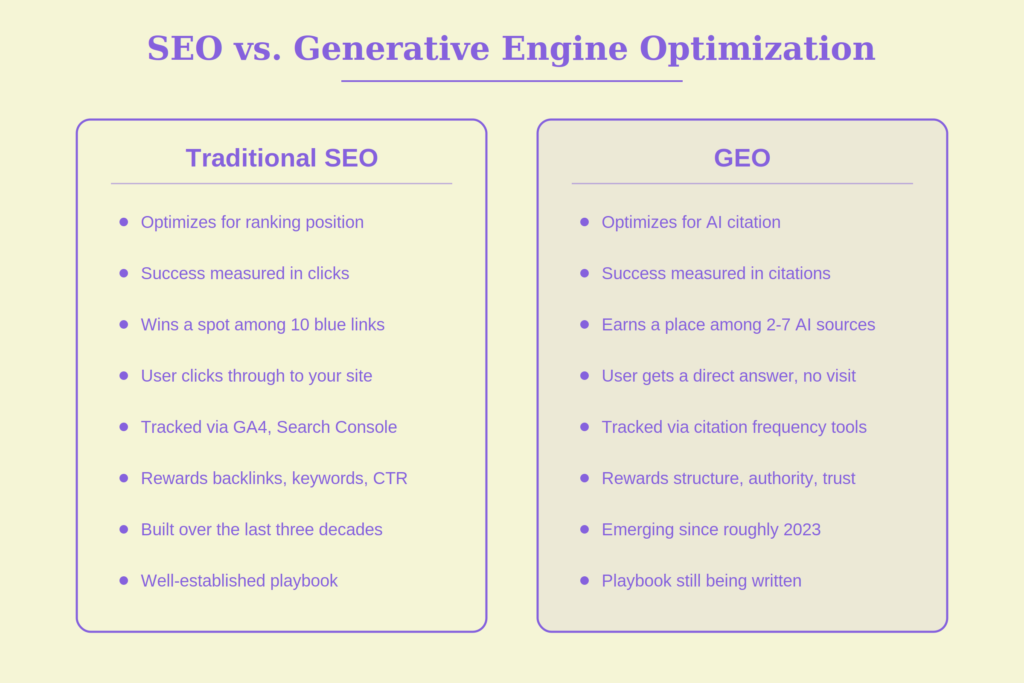
It’s tempting to treat Generative Engine Optimization as Search Engine Optimization with a new coat of paint, but the two disciplines reward different things.
Traditional SEO optimizes for ranking position. Success is measured in clicks, impressions, and where you land on a results page. Generative Engine Optimization optimizes for citation. Success is measured by how often an AI model references your brand, how accurately it represents you, and whether it recommends you at all.
This distinction matters practically when it comes to General Engine Optimization. A page that ranks well on Google isn’t automatically a page that gets cited by an AI model. Research circulating among General Engine Optimization specialists this year has pointed to a shrinking overlap between top-ranking Google pages and the sources AI tools actually choose to cite — a gap that’s grown noticeably wider over the past year. That doesn’t mean SEO is obsolete. It means SEO has become necessary but no longer sufficient.
The two disciplines still share a foundation. AI systems rely on live web search to generate many of their answers, which means strong technical SEO will have fast load times, clean architecture, mobile optimization, crawlable pages, still feeds directly into GEO performance. But layered on top of that foundation, GEO asks for something SEO never required: content built specifically to be lifted, summarized, and quoted by a machine that’s trying to answer a question in a single response.
Why Generative Engine Optimization Matters Right Now
Three forces are converging to make 2026 the year GEO stopped being optional.
AI search adoption has moved past the experimentation phase. People are starting to like artificial intelligence platforms more than others just like they used to choose a favourite search engine. Now this liking for an artificial intelligence platform is becoming a regular thing that they do rather than something new and exciting. They are forming loyalty, to artificial intelligence platforms and this loyalty is turning into a habit when it comes to using artificial intelligence platforms.
The gap between adopters and non-adopters is what we are really talking about here.
Big marketing teams have already figured out how to use General Engine Optimization in their work. Smaller teams and teams, with size are not doing as well with this. This means that agencies and brands that are willing to try GEO now can get a head start. They do not have to wait for everyone to do it first. Agencies and brands that use GEO now can be the first to do so which is an advantage. GEO is something that smaller and medium sized teams are still trying to learn about.
The industry’s biggest blind spot is definitely measurement.
Marketers who’ve spent years perfecting their Google Analytics dashboards often have no equivalent visibility into how their brand performs inside AI-generated answers. A new category of tools has emerged specifically to close that gap, tracking metrics like AI citation frequency, brand representation accuracy, and share of voice within generated responses — evidence, in itself, that this is a discipline agencies and enterprises are actively investing budget into, not just discussing.
There’s also a behavioural shift worth naming directly. Younger audiences are turning to AI tools as their default starting point for research questions at a noticeably higher rate than older generations. That’s not a short-term issue, with one product launch. It’s a pattern that happens across generations. It gets worse over time.
Core Elements of a Working Generative Engine Optimization Strategy
1. Build Content Around Direct, Citable Answers
AI systems like it when things are clear and easy to understand. They do not like it when you have to read a lot of stuff before you get to the main point. A page that gets straight to the point is more helpful to an AI system than a page that has a lot of extra words before it says what it really means. The AI system wants to find the answer accurately. It is better when a page says what it means away.
This does not mean that you should remove all the details or the personality from the content. AI systems and people, like the Google AI system reward clarity over cleverness. The Google AI system is a type of AI system. Clarity is what the AI system likes. It means front-loading the answer, then using the rest of the piece to build context, credibility, and depth. When we write it is really helpful to use formats.
We can use headings and comparison tables to make things easy to understand. Numbered frameworks are also very useful. We should try to sum things up in concise summary blocks. This way people can find the information they need and remember it easily. Structured formats like these are a lot better than writing paragraphs that go on and, on.
2. Structured data is really important. It should be a part of all our plans.
Schema markup is not something nice to have anymore. It is really important for Generative Engine Optimization. The JSON-LD structured data helps the artificial intelligence systems understand your products and services and what people think of them. It also gives them information about your organization. This way the systems do not fill in the gaps with wrong information that they find somewhere else. Schema markup and JSON-LD structured data are important for Generative Engine Optimization because they give the systems the information, about your products and services.
3. You want to build authority that goes beyond your website.
AI models don’t just evaluate your site in isolation. They weigh how often and how consistently your brand shows up across the broader web — industry forums, guest contributions, podcast transcripts, credible third-party mentions, and open discussion platforms all feed into the picture a model builds of your authority. A brand that only exists on its own domain is easier for a model to overlook than one that’s referenced consistently across multiple independent, trustworthy sources.
Original research carries particular weight here. A benchmark study, a proprietary dataset, or a genuinely unique framework built from real experience gives an AI model a reason to cite you specifically, rather than one of several interchangeable competitors covering the same generic ground.
4. Keep Content Current
AI systems weigh recency heavily when selecting which sources to cite. If you write a good guide and then you do not update it a newer guide on the same topic will be better. This is true even if your guide was really good when you first wrote it. You should update your content regularly. You should add information to it and say when you last updated it. This shows people that your content is still good and relevant. Old content that never changes is not as good, as content. You need to keep updating your cornerstone content to make it stay relevant.
5. Keep changing where you or your company want to show up
Discovery no longer funnels through a single search bar. Audiences are asking questions. Making decisions on social media, voice assistants and retail websites. They’re also using different AI tools, not just one. If you focus on one platform your strategy is weak. You need to be present on all the platforms your audience uses. This way you’re protected if one platforms algorithm changes. It’s all about being where your audience is. They use platforms so you should too.
6. Measure what cannot be seen
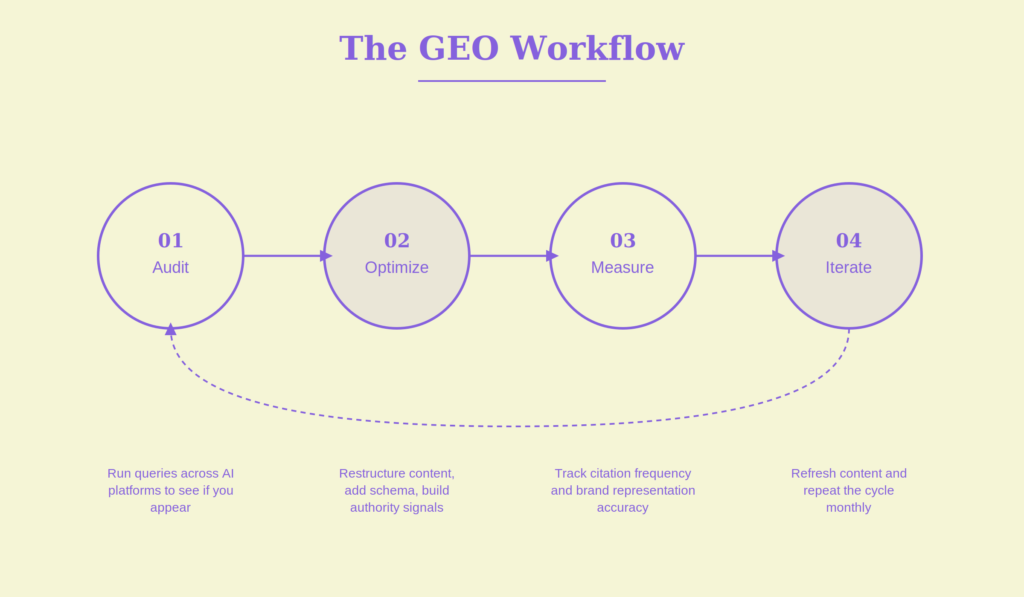
This is the piece most teams are still missing. Begin with something simple: identify ten to twenty queries genuinely relevant to your business, particularly the kind someone asks right before making a purchasing decision. Run those queries through ChatGPT, Perplexity, and Gemini. Note whether your brand appears, how accurately it’s described, and which sources the model pulled from instead if you’re absent. This manual audit costs nothing but time, and it will tell you more about your current GEO standing than any dashboard.
Common Mistakes Brands Are Making with Generative Engine Optimization
The biggest mistake people make with GEO is not that they do not use it at all. It is that they think of it as a problem with the content. GEO is actually a combination of content strategy, technical SEO, PR and product marketing. If you only give the job of GEO to the content team without getting help from the team and people who know about structured data you will end up with content that sounds good but search engines like Google will still not be able to find it because of problems, like blocked robots.txt files or poorly structured markup.
Another common mistake people make with General Engine Optimization is trying too hard to use keywords like companies used to do with traditional SEO. Generative Engine Optimization doesn’t reward keyword stuffing. It rewards genuine expertise expressed clearly. Vague, hedge-everything language rarely earns a citation, because it gives a model nothing concrete and specific to extract.
A third mistake is thinking GEO takes over SEO of adding to it. Giving up technical SEO to follow AI visibility is not a good idea. This is because AI models still rely a lot, on web search results and backlink signals to decide what is trustworthy.
A Practical Starting Checklist for Generative Engine Optimization
If you’re beginning a Generative Engine Optimization strategy this quarter, a focused starting point works better than trying to overhaul everything at once:
- Look at five to ten pages and rewrite the beginning of each page to give a straight answer that people can quote.
- Check that your robots.txt file is not stopping AI crawlers by mistake.
- Update special data called JSON-LD to the most important pages on your website.
- Figure out what your customers are really trying to ask and make one page that answers each question.
- Make sure your company description and main message are the same they appear online.
- Get a few reviews, from other trusted websites instead of trying to get a lot of them.
- Do the manual check for AI queries that I mentioned earlier and do it again every month to see what is changing with the Audit and your cornerstone pages and the robots.txt file and the JSON-LD structured data and the customer questions and the company description and the third-party mentions.
This is a version of a GEO system. It is not a plan. It is a good starting point. It is better, than waiting for a plan before doing anything. The GEO system gives us a place to begin.
Where Generative Engine Optimization is Heading
Generative Engine Optimization is still a field and people are figuring it out as they go. This can be uncomfortable, for marketers who are used to following established rules. It is also a chance for brands to get ahead. The brands that are willing to try things see what works and make changes quickly are the ones that will have an advantage. This advantage will be hard to catch up to once everyone else understands how it works.
Traditional search is not going away. The basics of Search Engine Optimization are still important. People do things differently now when they find and choose brands it has changed a lot over time. Search Engine Optimization is still something we need to think about. This change is happening fast.
Most marketing teams have not been able to keep up. Generative Engine Optimization is changing how people find, evaluate and choose brands. It is continuing to change quickly. Treating GEO as a side experiment rather than a core part of your visibility strategy is, at this point, a choice to fall behind — quietly, and probably without immediate feedback that it’s happening.
The brands paying attention now are the ones who’ll still be visible when the answer, not the link, is all most people ever see.
Talk more about this with our team and see if it helps your business. Get in touch with Apex Conversions.